For the latest news and updates, subscribe to the MADE Newsletter 

By
Healing The Cut
May 18th, 2026

Healing The Cut

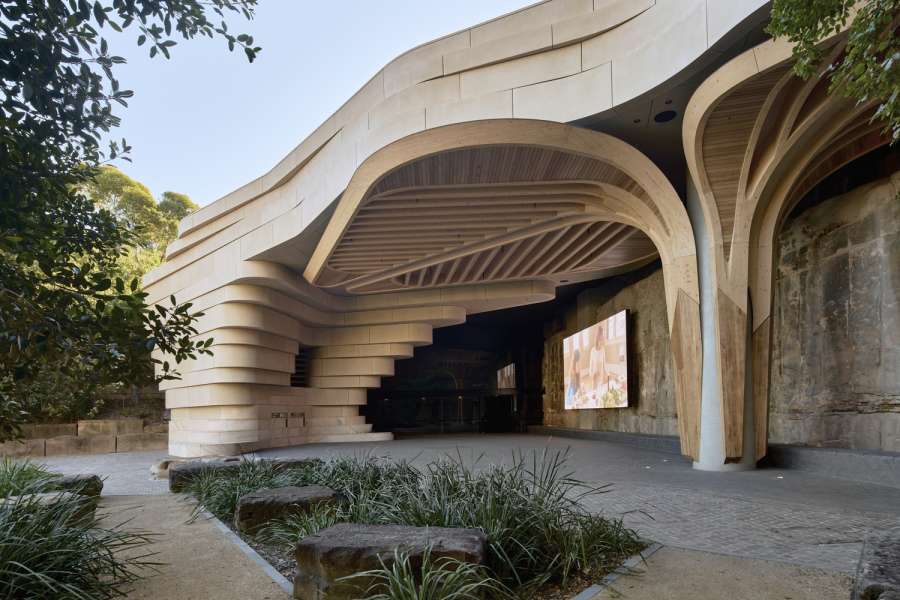
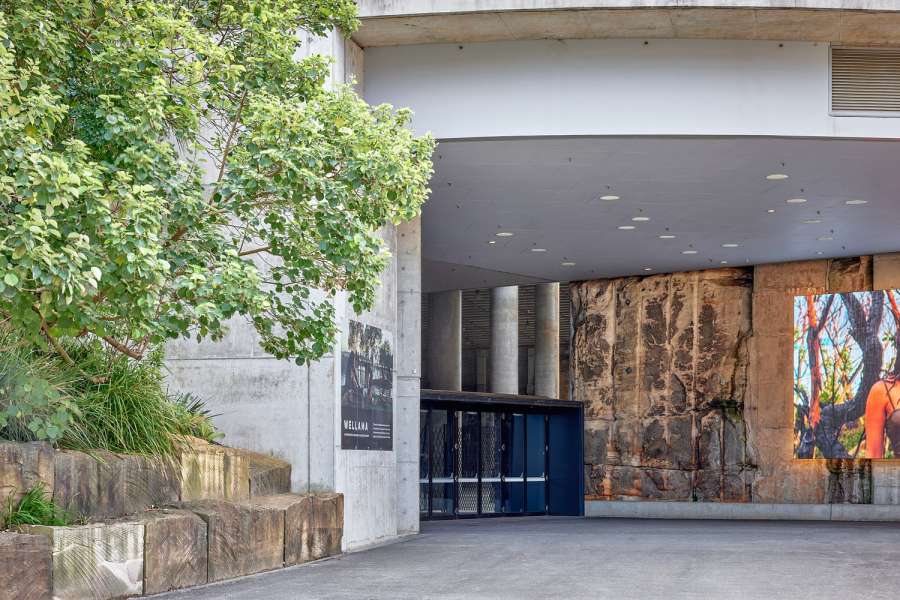
Long before it became one of Sydney’s most distinctive culture and event spaces, The Cutaway at Barangaroo was a cavernous void carved into the landscape. “The whole reason The Cutaway exists,” explains Architect and Senior Associate at fjcstudio, Cassandra Halpin-Smyth, “is because this huge cut basically took it all away to make way for the maritime industry and shipping imports, many, many years ago.” What remained was powerful, but unresolved: an immense concrete shell embedded within the Barangaroo headland. The ambition of The Cutaway’s transformation, in collaboration with FDC and Infrastructure NSW, was not simply to redesign the space, but to respond to that history.

“From the very beginning, we wanted to heal the cut that was left behind,” Halpin-Smyth says. That intent became the foundation of a deeply collaborative process, shaped alongside Indigenous spatial design practice, Bangawarra, and artist and former head designer at Bangarra Dance Theatre, Jake Nash. Together, the team developed a design language grounded in Country as a guiding principle. “We used references to saltwater Country, the caves and the trees found along the coastline around the Barangaroo area,” she explains.

For Kate Holmes, Project Director at Infrastructure NSW, the strength of the project lay in its shared intent. “There was a real commitment across the whole team to protect the design intent,” she says. “Everyone stayed faithful to the original vision. If you compare the early renders to what’s been built, they’re remarkably similar, and that level of consistency doesn’t happen by accident. It comes from discipline, alignment and committment throughout the design and construction periods.”

A Forest Within

Where the original Cutaway was defined by its scale and starkness, the new design shifts the experience inward. It is softer and more atmospheric but no less awe-inspiring.

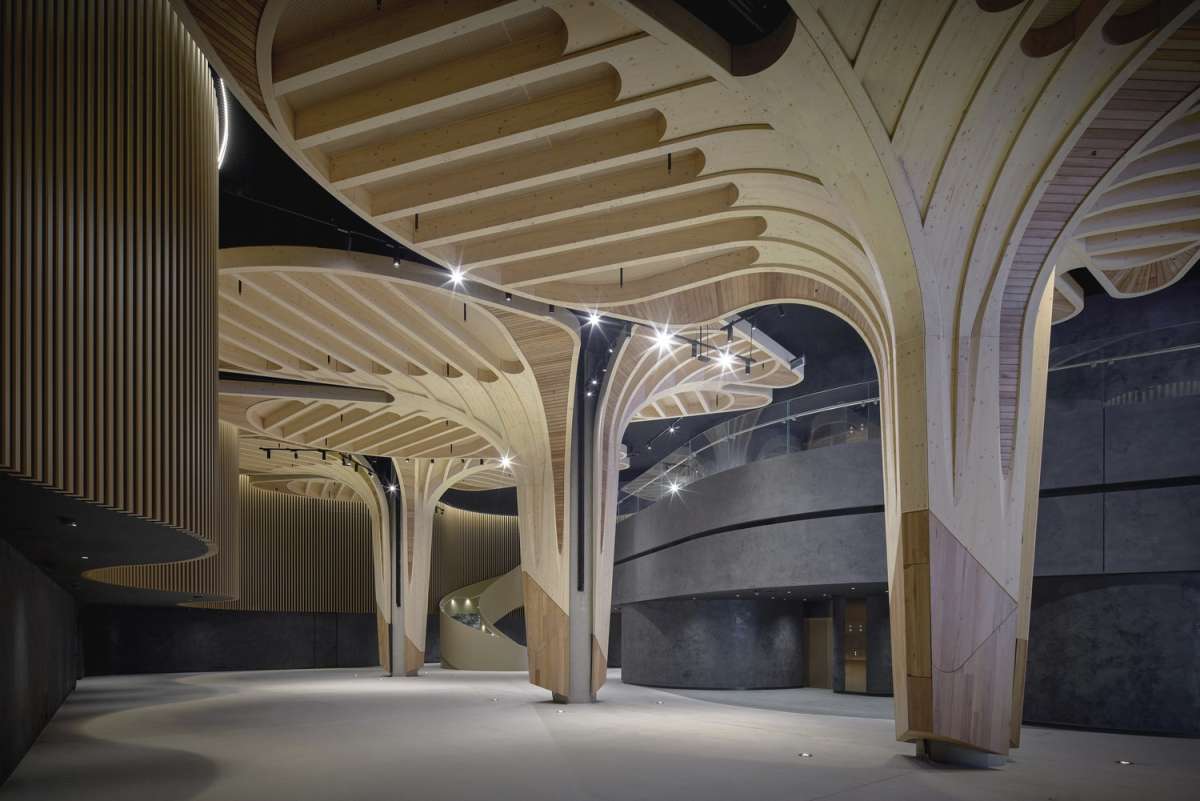
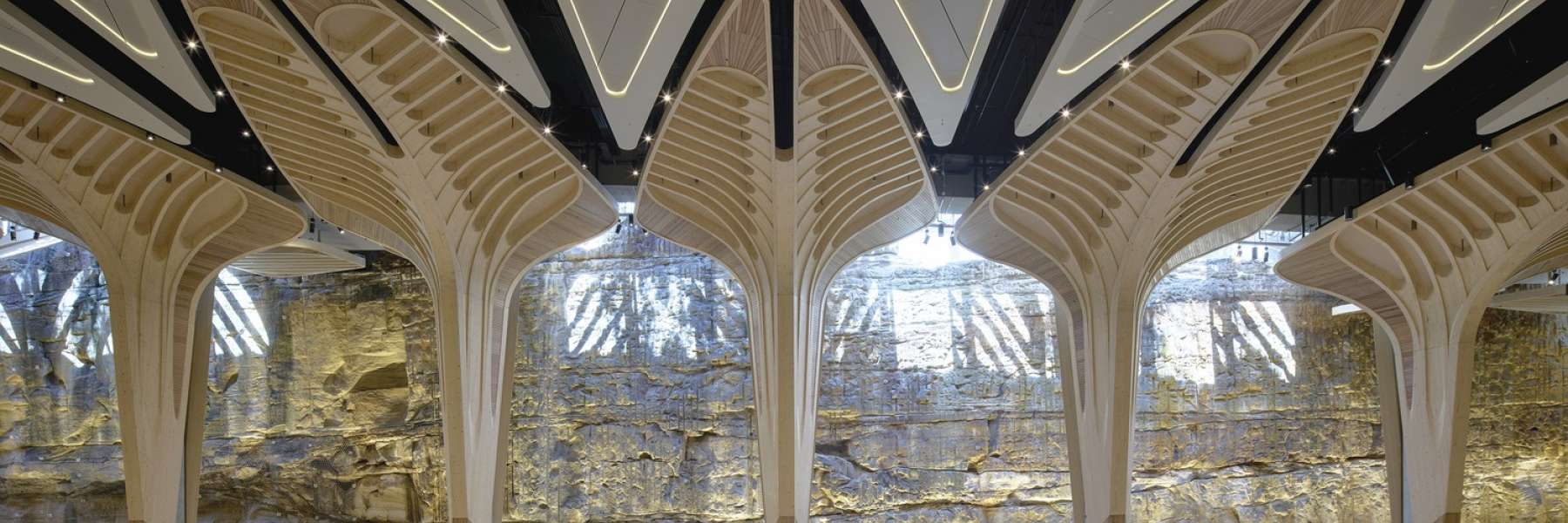
“We were really trying to soften the interiors and make it a welcoming and inclusive experience,” says Halpin-Smyth. Central to this is the idea of shelter, expressed through the Damun, or Port Jackson fig trees native to the site. Reimagined as towering sculptural forms, they anchor the space both physically and symbolically. “We came up with the idea of shelter using the trees,” she says. “It’s quite a moody experience, but one that feels welcoming and supported.”

Delivering that ambition required a level of construction precision rarely seen at this scale. “Each of those trees has more than 130 individual components, and no two are the same,” says FDC General Manager, Fitout & Refurbishment NSW, Ben Dircks. “They’re not typical timber elements. Every piece had to be machined from solid blocks and assembled almost like a model.”

Manufactured in Germany and coordinated across continents, the process demanded absolute confidence in the design before anything arrived on site. “You’re relying on that entire chain, design, fabrication, shipping, to come together perfectly,” Ben says. “And then you start putting it together and see if it works the way it should.” It does. Rising up to 18 metres high and spanning vast distances across the interior, the timber structures are as technically ambitious as they are aesthetically impressive.

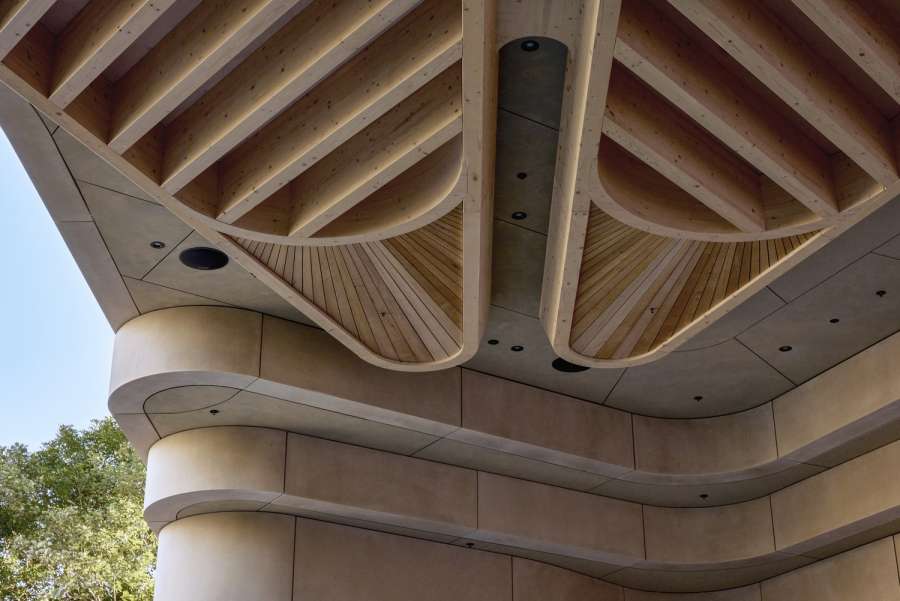
“They’re huge,” Cass says. “It’s kind of hard to explain the scale unless you’re there.” Constructed from a combination of European timber, selected for its ability to achieve complex curvature, and Australian hardwoods at key touchpoints, the trees are both tactile and performative. They hold rigging for events, contribute to the acoustics, and create a layered spatial experience. They transform the scale of the space, breaking down what was once an overwhelming void into something more intimate.

A Profound Welcome

That sense of experience is carefully choreographed from the moment of arrival. “We thought very carefully about that entry experience and how you come into the building,” Cass explains. “When you enter, it’s quite a dark space. We wanted you to feel calm and welcomed. It’s like the experience of being in a cave.” The ceiling lowers. The atmosphere compresses. And then the space opens, expanding into the vast event hall beyond.

Even light is treated as a material. Filtered through skylights above and catching on sandstone walls and timber forms, it moves across the space in subtle, shifting ways, reinforcing the connection to the landscape outside.

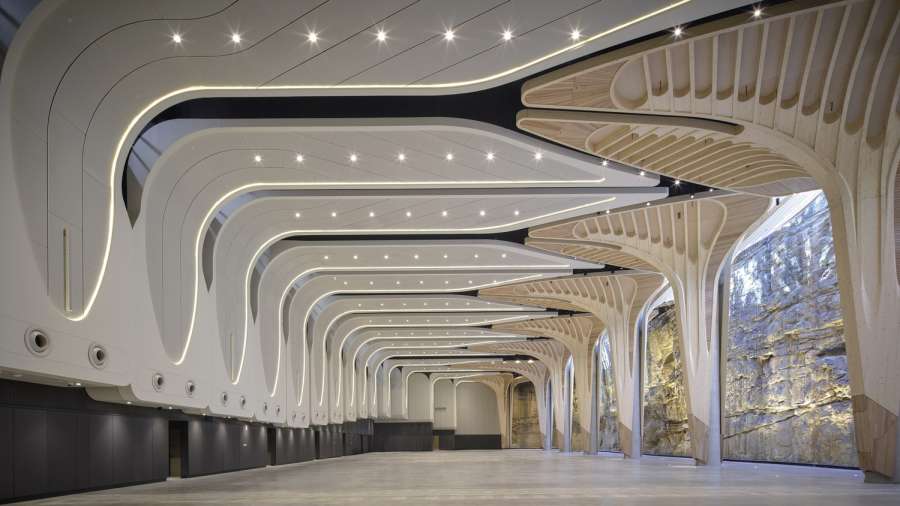
Acoustic performance was integral to the design. The sculptural “acoustic shells” within the event hall had to interlock precisely with the timber elements, while concealing services and supporting performance infrastructure. “It required a lot of coordination,” Cass explains. “The geometry is super complex. We were having weekly calls to resolve it.” Close collaboration became critical, particularly with FDC. “From the design managers through to the subcontractors, they genuinely cared about the building as much as we did,” she says.

For Ben, that collaboration extended beyond coordination into problem-solving at every level. “This isn’t a typical installation where you can rely on standard systems,” he says. “Almost everything here had to be developed, tested and refined specifically for this space.” That approach was evident throughout. “What stood out was FDC’s solutions-focused mindset,” Kate says. “When issues arose, they came to us early with options and worked collaboratively to resolve them. That level of transparency isn’t always a given, and it builds trust. There were also some late design changes, particularly in the pre function space, to improve flexibility. FDC coordinated closely with the design team to incorporate them smoothly and without disruption. That kind of seamless coordination is a real strength.”

With residential buildings sitting a stone's throw away, the FDC team had to engineer entirely new solutions to contain sound within the cavernous volume. “We worked closely with acoustic specialists to develop systems that hadn’t really been used in this way before,” Ben explains. “They were tested, adjusted, then tested again in situ, because this space doesn’t behave like a normal building.”

The Cutaway is a highly constrained site, with a single primary access point and limited space for movement. “There was only one main way in and out,” Kate says. “At times there were up to 320 people working in the main event hall, so it required a high level of organisation, planning and discipline.” That discipline extended to safety. “FDC maintained a strong safety culture throughout, including daily processes to manage what was happening on site and mitigate risk,” says Kate. “The project achieved zero lost time injuries, which reflects the seriousness with which safety was treated.”
Space Within Space

Built on land of deep cultural significance, The Cutaway required close engagement with First Nations communities throughout delivery, from consultation and ceremony to meaningful participation on site. “It wasn’t just about building the space,” Ben says. “It was about how we worked within it, making sure we were engaging with community, creating opportunities, and respecting the significance of where we were.”

Indigenous participation extended across the project, from skills development and employment pathways to partnerships with local businesses. Even the construction process itself became a point of connection, a shared contribution to what the space would become.

While the event hall remains the spatial heart of The Cutaway, the reimagined building is far more layered, accommodating performance, back-of-house facilities, office spaces and a dedicated First Nations education area. Yet for Cass, the most compelling moment is not necessarily the grandest. “I really love the pre-function space,” she says. “It’s very atmospheric… a place where you feel supported before you enter the larger volume.” Here, the trees feel closer, the scale more intimate and the architecture more personal.

For all its complexity, Cass says The Cutaway resists being reduced to a single detail or gesture. “I think it’s a space that should be viewed as a whole,” she reflects. “There are moments, like the interplay of acoustic forms and timber structures, the glimpses of concealed technical systems that reveal themselves slowly. Others remain intentionally out of reach, sensed rather than seen. It’s quite hard to narrow in on certain details,” she says. “There’s a lot happening behind just what you see.”

A Landmark Redefined

In reimagining The Cutaway, the project does not erase what came before. Instead, it acknowledges its history while reshaping its meaning. As Cass describes it, what was once a scar in the landscape has become something else entirely: a place of gathering, of performance, of cultural expression: a shelter. And for those who built it, the significance is not lost.

“When you step back and look at what’s been created here, you realise it’s something special,” Ben says. “Not just in how it looks, but in what it represents: the history, the collaboration, the relationships, and the effort behind it.”

For Kate, that outcome is ultimately a reflection of how the project was approached from the beginning. “Strong collaboration, transparency and a shared commitment to the vision,” she says, “that’s what made this possible.”

Photo Credit: Toby Peet